

Legal challenges involving intellectual property rights that transcend national boundaries are known as cross-border intellectual property (IP) disputes. Since different countries have unique legal systems and regulations, these disputes can become complicated. The legal framework for addressing intellectual property disputes that span national borders is influenced by a number of international treaties, agreements, and national legislation.
Trade-Related Aspects of Intellectual Property Rights (TRIPS Agreement) is one example of an international treaty or agreement. TRIPS, which is governed by the World Trade Organisation (WTO), establishes minimal requirements for the protection of intellectual property, such as trade secrets, trademarks, patents, and copyrights. The Paris Convention for the Protection of Industrial Property defines the idea of national treatment for international intellectual property holders and offers a framework for the protection of intellectual property, including patents, trademarks, and designs.
Authors’ and creators’ works are protected in member nations by the Berne Convention for the Protection of Literary and Artistic Works, which oversees copyright protection. By bringing its member states’ IP laws into line, the EU has also created a uniform framework for IP enforcement and protection. Furthermore, African Intellectual Property Organisation (OAPI) promotes collaboration in the area of intellectual property amongst African nations. The laws and rules pertaining to intellectual property are unique to each nation. These legal frameworks can differ greatly between states, which can affect how cross-border disputes are settled. Every nation has a unique system in place to protect intellectual property rights. Depending on the type and severity of the infringement, this could entail administrative procedures, criminal charges, or civil litigation.
It can be difficult to choose the right jurisdiction in a cross-border intellectual property dispute. International agreements and conventions may offer direction on matters of jurisdiction. In cross-border intellectual property conflicts, the recognition and execution of foreign judgements may be crucial. Conventions and treaties may serve as a foundation for the acceptance and execution of intellectual property rulings in various legal systems. To stop the import or export of goods that violate intellectual property rights, many nations have set up customs processes. International agreements like the Agreement on Trade-Related Aspects of Intellectual Property Rights (TRIPS) are frequently followed by these measures. It’s crucial to remember that handling cross-border intellectual property issues calls for cooperation between legal experts with knowledge of the pertinent legal systems and a thorough grasp of the particular legal frameworks involved.
ADR processes such as arbitration and mediation are crucial in resolving disputes involving intellectual property (IP) that are shared across borders. In order to speed up the resolution process, arbitrators are neutral third parties who are often versed on intellectual property law. Arbitration’s neutrality and the fact that the parties can choose arbitrators with specific expertise in the subject matter are two of its main benefits. Furthermore, arbitration procedures are frequently private, protecting crucial company data. Another important benefit is the capacity of arbitral rulings to be enforced internationally owing to international conventions. One drawback, though, is that there isn’t any prior legal precedent, which can result in less predictable results.
In contrast, a neutral mediator helps parties in dispute come to a voluntary settlement through mediation. This approach emphasises open communication and negotiation and is more collaborative. One of the main benefits of mediation is that it can help to maintain the relationships between the parties involved, which is important when working in a business setting where continuous cooperation may be desired. Due to mediation’s flexibility, each party can customise a solution to meet their unique needs, giving them a greater sense of control over the final result. Parties may need to turn to litigation or arbitration if a settlement cannot be reached due to mediation’s non-binding character, which means that any agreement made is not always enforceable. Enforceability issues can come up, especially when working with partners that are governed by different regulations.
Whether arbitration or mediation are used, alternative dispute resolution (ADR) methods have a number of benefits when it comes to IP disputes. Efficiency is a major advantage since alternative dispute resolution (ADR) procedures can result in faster results than traditional litigation. This is particularly helpful in the quickly developing fields of innovation and technology. Choosing decision-makers with specialised expertise of intellectual property law, such as arbitrators or mediators, guarantees a deeper comprehension of the legal and technical complexities involved. ADR procedures are also renowned for their adaptability, which enables the parties to develop original and customised solutions that are suited to the particulars of the disagreement.
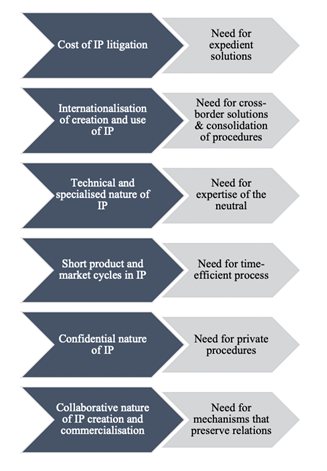
An excerpt from Singapore International Mediation Institute showing the intricacies of ADR in IP matters
ADR mechanisms also possess disadvantages despite their benefits. Due to the lack of binding precedent, rulings may result in a lack of clarity regarding the application of the law. Enforceability issues could come up, especially with mediated settlements because the procedure doesn’t always produce a legally binding agreement. IP conflicts involving significant matters of public policy may also be difficult for ADR to resolve; instead, these cases may be better served by traditional litigation, which allows for the establishment of legal precedents. In conclusion, thorough evaluation of the particular circumstances, the preferences of the parties involved, and the nature of the dispute itself is necessary when deciding between arbitration, mediation, or traditional litigation for cross-border intellectual property disputes. Every approach has advantages and disadvantages, so a wise choice should weigh the expected results, potential effects on long-term business relationships, and cost factors.
It is crucial to carry out extensive intellectual property (IP) due diligence prior to entering new markets. This procedure entails a thorough examination of all currently in use patents, trademarks, copyrights, and trade secrets in order to determine their legality, enforceability, and likelihood of infringement. Recognising and comprehending these risks is essential to avoiding accidental violations of pre-existing intellectual property rights in the intended market, hence reducing the likelihood of expensive legal conflicts and safeguarding the brand’s image. Additionally, by conducting IP due diligence, companies may better match their market entrance strategy with the local intellectual property landscape. This allows them to make the required modifications to their products, branding, and licencing agreements to guarantee compliance with the country’s unique IP legislation.
In order to reduce the likelihood of litigation, companies should create thorough intellectual property plans that include a range of preventative actions. Proactive IP portfolio management is part of this, entailing frequent audits and updates to match IP assets with corporate goals. By establishing a foundation for brand recognition in new markets and offering greater protection, global trademark registration lowers the possibility of infringement claims. Legal complexities can be navigated and local expertise can be leveraged through licencing agreements or relationships with local entities, all while reducing the likelihood of litigation. A comprehensive strategy includes putting in place strong monitoring and enforcement plans, teaching staff members about intellectual property protection, and including alternative dispute resolution (ADR) procedures in contracts. Furthermore, companies are better prepared for any future problems by having a clear strategy for IP litigation, which includes knowing the local legal procedures and taking settlement offers into account. All things considered, these all-encompassing IP strategies support a company’s long-term viability and performance in new markets in addition to safeguarding investments and assets.
Managing IP issues pertaining to concepts and works of art requires a proactive and strategic approach, which is equivalent to having a well-thought-out plan in place beforehand. It’s similar to planning ahead and making sure everything is in place before beginning a new endeavour, such as offering goods or services in another part of the world. Being proactive entails anticipating issues rather than waiting for them to arise. A company investigates possible problems and develops remedies in advance of problems occurring. In terms of IP, this can entail routinely reviewing and revising the safeguards in place for the business’s concepts, trademarks, and other works of art.
It entails making deliberate choices based on long-term objectives and the wider picture. In the context of intellectual property, a strategy entails considering how to safeguard the business’s concepts, collaborate with third parties safely, and resolve disputes without escalating into lengthy legal disputes. It is crucial to approach IP issues with both proactivity and strategy. It enables a company in staying out of trouble and navigating rules and regulations with ease. A company can avoid legal issues, preserve its reputation, and ensure that all the necessary procedures are followed before entering new markets by being proactive and smart in its strategy. In this manner, it is prepared to meet obstacles head-on and proceed without unnecessary holdups. Being proactive and strategic is like having a trustworthy map to successfully navigate the universe of ideas and inventions.
Disclaimer: The information provided above if for informational purposes only and should not be considered as legal advice.
Keywords:
Comments are closed